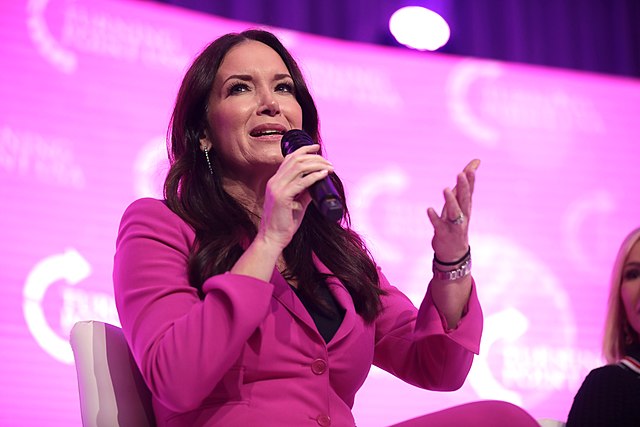
Credit: Gage Skidmore
In another key confirmation vote, the Senate has officially approved Brooke Rollins as the new Secretary of Agriculture, further shaping the Biden administration’s cabinet. Despite initial uncertainty surrounding her nomination, Rollins secured enough votes to be confirmed, solidifying her role in overseeing U.S. agricultural policy, food security, and rural development programs.
This confirmation follows the contentious approval of Robert F. Kennedy Jr. as Secretary of Health and Human Services, where Senator Rick Scott of Florida provided the crucial vote to push RFK Jr. over the threshold.
Rollins’ Road to Confirmation
Rollins, a former Trump administration official and key figure in the America First Policy Institute, was a controversial pick for Agriculture Secretary. While praised by conservatives for her pro-business stance and deregulation efforts, some lawmakers questioned her lack of direct agricultural experience.
Despite these concerns, Rollins successfully navigated the confirmation process, emphasizing her commitment to:
✅ Expanding U.S. agricultural exports
✅ Reducing regulatory burdens on farmers
✅ Strengthening rural economies
✅ Addressing supply chain disruptions in food production
Her confirmation was ultimately less divisive than RFK Jr.’s, as she enjoyed broader GOP support—though some Democrats remained skeptical of her ties to corporate agribusiness interests.
McConnell’s Influence & GOP Power Struggles
The approval of both RFK Jr. and Rollins highlights growing fractures within the Republican Party. Senate Minority Leader Mitch McConnell broke with the party on RFK Jr.’s nomination, while Rick Scott’s decisive vote helped push it through.
Rollins, however, enjoyed more unified Republican backing, showing that Trump-era officials still wield significant influence in key policy areas. With her experience in economic policy and deregulation, her leadership at the USDA could mirror Trump’s approach to agriculture—prioritizing business-friendly policies over regulatory expansion.
What’s Next for Rollins at USDA?
As Secretary of Agriculture, Rollins now faces major challenges, including:
🌾 Navigating U.S.-China agricultural trade tensions
🌾 Supporting farmers dealing with climate change & extreme weather
🌾 Expanding rural broadband and infrastructure
🌾 Ensuring stable food supply chains amid global instability
Her success will depend on her ability to balance industry interests with the needs of small farmers and rural communities.
Final Thoughts: A New Era for U.S. Agriculture?
With Rollins now at the helm of the USDA, Trump-aligned policies may see a revival, but her ability to deliver tangible results remains to be seen. Meanwhile, the Republican Party’s internal divisions—highlighted by McConnell’s defiance on RFK Jr. and Scott’s critical vote—continue to shape the future of legislative battles.
One thing is certain: agriculture policy will be a central focus in the coming years, and Rollins’ leadership will play a key role in shaping the industry’s direction.
What do you think?
Will Rollins be a strong advocate for farmers, or will corporate interests dominate her tenure? Let’s discuss.
 Bills at the Hill
Leave a comment